
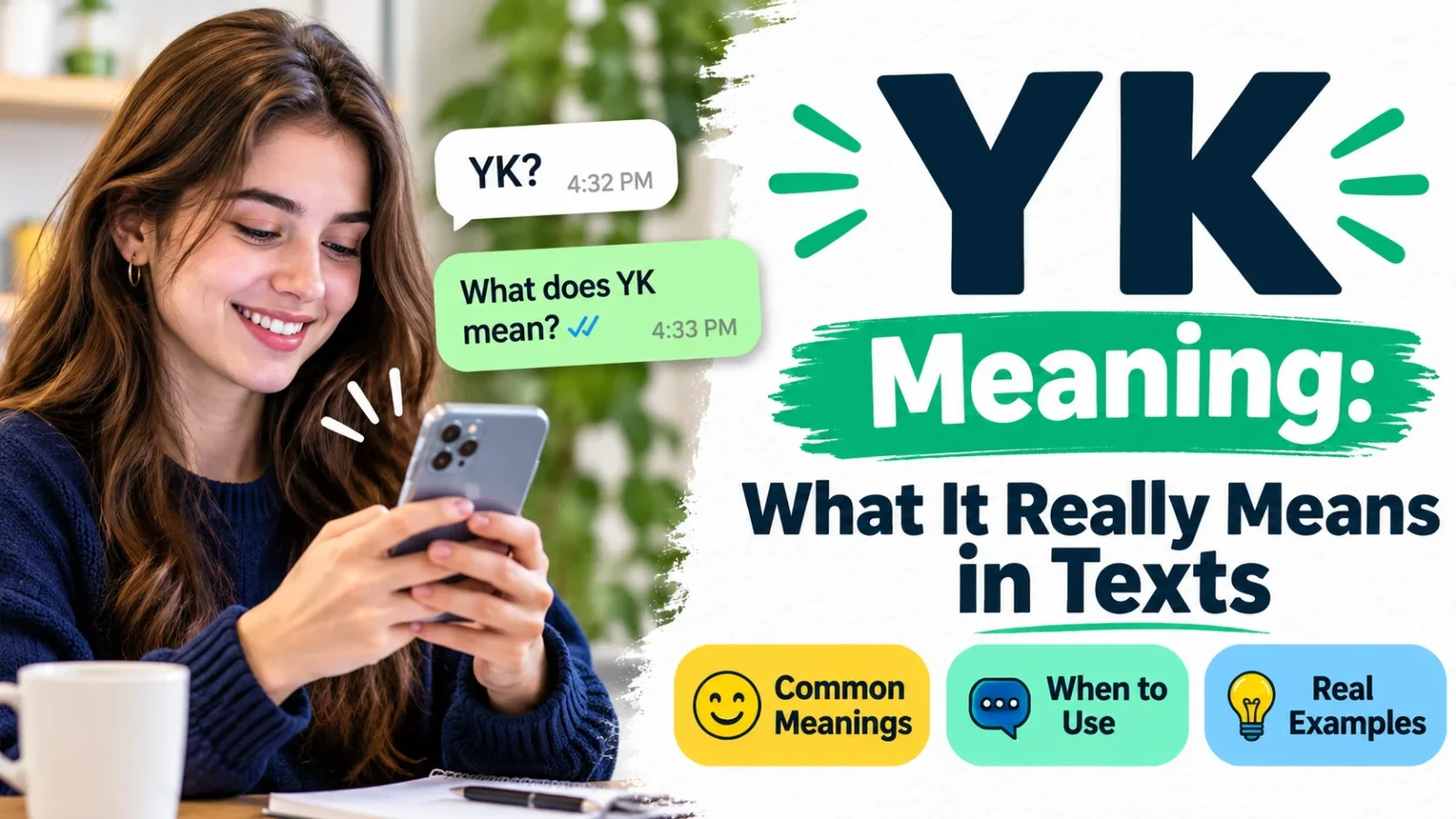
You are scrolling through Snapchat or iMessage and a friend texts: ‘I really need a vacation, yk?’
Are they asking if you know about their vacation plans?
Or are they just looking for you to nod along and agree?
That tiny two-letter abbreviation is YK, and it appears in millions of text messages every day.
YK Quick Reference & Etymology Overview
| Attribute | Details & Specification |
| Full Form | You Know |
| Origin Language | English (Early SMS & Chatroom Shorthand) |
| Tone & Formality | Informal, casual, friendly, non-professional |
| Primary Platforms | Snapchat, TikTok, iMessage, WhatsApp, Discord, X |
| Related Slang Terms | IKR (I Know Right), IDM (I Don’t Mind), JS (Just Saying) |
| Grammatical Roles | Filler phrase, confirmation question, conversational agreement |
| First Recorded Era | Late 1990s (160-character mobile SMS era) |
It saves keystrokes while maintaining warmth and shared understanding.
When used correctly, it creates an atmosphere of easy familiarity.
However, misreading internet shorthand can lead to awkward moments.
Does the sender expect an answer, or are they making a statement?
This guide explains the true meaning of YK, its historical origin, and how to respond naturally.
Example: Before diving into complex chat examples, review the foundational facts behind this acronym.
The Primary Meanings of YK in Text Messages
While YK directly stands for ‘You Know’, speakers use it in several distinct conversational ways. Understanding these subtle differences prevents confusion during fast-paced text chats. Below are the three primary applications found in modern digital communication.
1. Confirming Shared Knowledge and Background Context
Example: Texters frequently use YK to remind the other person of an established fact. In this context, it replaces the spoken phrase ‘as you already know’. It references mutual memories, shared schedules, or well-known personal habits.
For instance, imagine telling a friend why you cannot attend an evening party. Instead of explaining your strict family rules all over again, you simply drop ‘yk’. It signals that the other person already holds the necessary context.
Example Dialogue: ‘I cannot stay out past nine tonight, yk how my parents get on weeknights.’
Here, YK acts as a friendly shorthand for mutual history.
Example: 2. Asking for Validation, Empathy, or Active Agreement
When placed at the end of a sentence with a question mark, YK becomes an invitation to agree. It translates directly to ‘do you see what I mean?’ or ‘do you agree with me?’
Digital conversations lack physical facial expressions and vocal tone. Because of this barrier, people add ‘yk?’ to check if their listener is emotionally on the same page. It invites a reassuring head nod across the screen.
Example: Example Dialogue: ‘That chemistry midterm was completely unfair, yk?’
The sender is not genuinely asking if you know the test exists. Rather, they are seeking validation for their frustration.
3. Acting as a Conversational Filler and Pausing Device
Just like in spoken English, people type YK while organizing their thoughts. It buys brief thinking time without halting the conversational flow. Spoken conversation relies on verbal pauses like ‘um’, ‘ah’, or ‘you know’.
In written text, typing ‘yk’ replicates that exact human rhythm. It softens blunt statements and prevents messages from sounding harsh or demanding.
Example Dialogue: ‘I really wanted to buy those sneakers today but, yk, rent comes first.’
Here, the acronym cushions the disappointment of having to be responsible.
4. Expressing Disbelief or Emphasizing a Point
In dramatic or gossipy conversations, YK can emphasize shock. Texters place it at the very start of an exclamation to prime the reader for surprising news.
Example Dialogue: ‘YK I saw your ex at the mall today, right?’ In this position, the letters grab immediate attention. It signals that important tea or gossip is about to follow.
The Linguistic Evolution and History of YK
Where did this abbreviation come from? The spoken phrase ‘you know’ has served as an English discourse marker for centuries. Sociolinguists trace verbal use back to early Middle English storytelling traditions.
Storytellers and playwrights used the phrase to keep audiences engaged. William Shakespeare frequently included ‘you know’ in his theatrical dialogue to reflect realistic common speech.
However, the abbreviation YK emerged during the late 1990s and early 2000s. Early mobile phones featured numeric T9 keypads with strict 160-character SMS constraints.
Typing eight keystrokes for ‘you know’ felt slow and frustrating. Cell phone carriers also charged hefty fees for each individual text message sent over the network.
Resourceful teenagers quickly created two-letter shortcuts to compress their thoughts. Reducing the phrase to just two letters saved precious screen space and messaging fees.
As instant messaging platforms exploded, YK gained universal recognition among younger internet users.
Today, modern smartphone keyboards have predictive swipe text. However, Gen-Z and millennial texters continue typing YK because brevity remains an emblem of internet culture. It conveys effortless coolness that full sentences rarely match.
Real-Life Chat Examples Across Popular Apps
Seeing how native texters use YK in daily dialogue makes usage second nature. Below are six realistic chat scenarios across modern messaging apps.
Scenario A: Making Weekend Plans on iMessage
Alex: Are you heading to the football game on Saturday afternoon? 🏈
Jordan: I really want to go, but yk I have to study for midterms 📚.
Alex: Ah true, your biology exam is Monday right?
Jordan: Exactly, so I am stuck in the library all weekend 😭.
Scenario B: Reacting to Surprising News on Snapchat
Mia: Did you hear Marcus got the lead role in the musical? 🎭
Chloe: Honestly he deserved it, yk? He practiced every afternoon ✨.
Mia: True, nobody worked harder than him this semester 👏.
Scenario C: Casual Venting in a Discord Gaming Channel
Dave: Train got delayed for the third time this week. Transit is awful, yk 🚆.
Sam: I feel your pain man, happens almost every morning lately 💀.
Dave: At this point I might as well buy a bicycle 🚲.
Scenario D: Expressing Relationship Hesitation on WhatsApp
Emma: Are you going to tell him the truth about the concert ticket? 🎟️
Liam: I will, but I am just nervous about his reaction, yk 😬.
Emma: He might be disappointed at first, but honesty is always better 💬.
Scenario E: Debating Pop Culture on TikTok Comments
User1: That season finale made no sense whatsoever 📺.
User2: It made complete sense if you watched episode four closely, yk 👀.
User1: Wait, did I miss an important clue during the flashback scene? 🤯
Scenario F: Declining a Social Invitation Politeness Check
Sarah: Do you want to grab dinner at the new sushi spot tonight? 🍣
Maya: Thank you for inviting me, but yk my budget is super tight right now 💸.
Sarah: No worries at all, we can cook pasta at my place instead! 🍝
Popular Variations and Sibling Acronyms
Internet slang creators often pair YK with other abbreviations to form expressive compound acronyms. Below are the most common variations you will encounter online.
1. YKTV (You Know The Vibes)
This viral slang phrase dominates Instagram captions and TikTok videos. It communicates that good times, positive energy, and stylish living are currently happening. When someone posts a photo by the beach with the caption ‘YKTV’, they are telling followers that life is good.
2. YKYK (You Know, You Know)
Texters repeat the letters for playful emphasis during inside jokes. It suggests that if you are part of the inner circle, no further explanation is necessary. It creates a feeling of exclusive camaraderie.
3. IYKYK (If You Know, You Know)
One of the most famous four-letter acronyms on the modern internet. It highlights exclusive insider cultural references, niche memes, or hidden restaurant spots. It challenges the reader to prove their cultural awareness.
4. YKWYD (You Know What You Did)
Friends use this dramatic acronym during humorous or semi-serious confrontations. It playfully accuses the other person of being mischievous without spelling out the details.
5. YK vs IKR (Understanding the Contrast)
Do not confuse YK with IKR. While both letters look similar, their functions differ sharply. YK stands for ‘You Know’ and seeks confirmation. IKR stands for ‘I Know, Right?’ and delivers enthusiastic agreement.
How to Respond When Someone Texts You YK
Knowing how to reply to YK depends entirely on how the sender used it. Below are four effective response strategies for common texting situations.
Response Type 1: Confirming Agreement
If the sender used ‘yk?’ to seek validation, respond with enthusiastic agreement. Great replies include: ‘Ikr, totally agree’, ‘Fr, no cap’, or ‘100%, you took the words right out of my mouth.’
Response Type 2: Acknowledging Context
If the sender dropped ‘yk’ to reference shared history, a simple acknowledgment works best. Try texting: ‘Yeah I remember’, ‘Totally understand’, or ‘Makes complete sense, don’t worry about it.’
Response Type 3: Asking for Clarification
Sometimes you genuinely do not know what the sender is referencing. In that case, do not pretend to understand. Reply honestly: ‘Wait, I actually don’t know, what happened?’ or ‘Fill me in, I’m out of the loop!’
Response Type 4: Playful Teasing
If a close friend uses YK dramatically, match their energy with witty sarcasm. Reply: ‘No, actually, explain it like I am five years old’ or ‘Should I know? My crystal ball is broken today.’
Capitalization Rules and Messaging Etiquette
Does letter casing alter the meaning of YK? In short, no. However, casing does subtly influence emotional intensity and social tone.
The Lowercase Style (‘yk’)
Typing ‘yk’ in all lowercase feels relaxed, effortless, and friendly. It is the preferred styling for everyday mobile texting among teenagers and young adults. It blends seamlessly into sentences without drawing excessive attention.
The Uppercase Style (‘YK’)
Typing ‘YK’ in full uppercase signifies stronger emotion, intense surprise, or firm conviction. For example, typing ‘YK THAT IS CRAZY’ conveys intense shock or excitement. Use capital letters sparingly to avoid sounding like you are shouting.
When Should You Avoid Using YK?
✅ When & How to Use (DOs):
- ✅ Use in friendly, casual conversations and everyday texts.
- ✅ Keep it natural and context-appropriate.
- ✅ Use lowercase in fast messaging apps.
❌ When to Avoid (DON’Ts):
- ❌ Avoid in formal business correspondence, legal documents, or job applications.
- ❌ Avoid overusing repeatedly in every sentence.